
Sportscaster Ernie Johnson Jr.
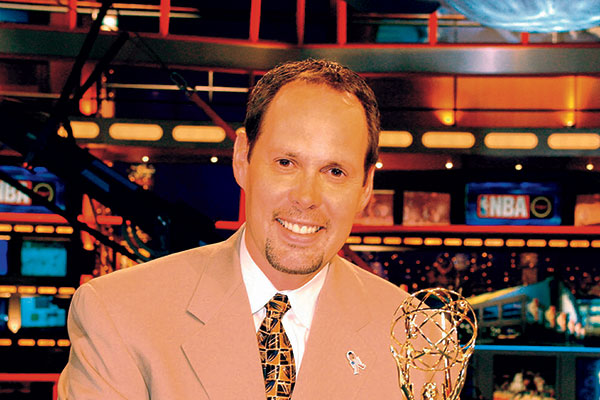 Photo courtesy of Turner Broadcasting
on Living with Non-Hodgkin Lymphoma
by Laura Shipp
Ernie Johnson Jr. is the host of TNT’s Inside the NBA, alongside former basketball stars Charles Barkley and Kenny Smith. He is also a play-by-play announcer for golf, basketball, and playoff baseball for both TNT and TBS. Ernie has twice won the Sports Emmy for Outstanding Sports Personality, Studio Host, once in 2002 (when he tied with Bob Costas) and again in 2006.
In 2003, Ernie was diagnosed with non-Hodgkin lymphoma after noticing some swelling on the left side of his face. Here, he shares his story with Coping® magazine.
Coping: What went through your mind when you were told you had cancer?
Ernie: There’s nothing that really prepares you to hear the word “cancer.” When the phone call came, our family was having dinner. My oldest son, Eric, was home from college, and I excused myself from the table to take the call. The call took about 15 minutes, and after I hung up and headed back to the kitchen, Eric said he and our youngest daughter, Carmen, were going to the video store.
“What should we get?” he asked. “Something funny,” I told him. After they left, my wife, Cheryl, asked if that was the doctor on the phone, and I told her the news. Needless to say, that was a difficult conversation to have.
Coping: What kind of treatment did you have?
Ernie: I remember the first day Cheryl and I went to the Winship Cancer Institute of Emory University. We were sitting in the waiting room thinking, “How did we ever wind up here?” It was surreal. I drank that delightful barium sulfate mixture and had a scan, and then I underwent a bone marrow test, which was as uncomfortable as the doctor had warned. Then came the waiting for results.
I wanted to send the message to people that even though you’re diagnosed with cancer you don’t need to go into hiding.
In many ways, that’s the hardest part because you simply can’t put it out of your mind, waiting for another phone call. As it turns out, the kind of NHL I had was not aggressive, and I didn’t feel bad physically. “Watchful waiting” was the initial course of treatment – visiting the doctor periodically to keep an eye on things with no other treatment required
Coping: What later prompted the move to begin chemotherapy?
Ernie: The decision to begin treatment didn’t come until nearly three years later. Late in 2005, the swelling in my face had begun to increase to the point that I thought it was noticeable to others. By February 2006, it became evident that there was something going on, so I was given what’s called a maintenance regimen, chemotherapy with a targeted medicine called Rituxan followed by Rituxan on its own for two years.
The fact that I made my living on TV complicated things. I became very self-conscious that it was apparent on the air that my face was swollen. That’s when I contacted the Turner Sports PR department and told them what I was dealing with and that I wanted to make folks aware of it. My doctor and I had agreed that we would begin treatment after the NBA season was over in June. I wanted to send the message to people that even though you’re diagnosed with cancer you don’t need to go into hiding.
Coping: How did having cancer affect your work?
Ernie: The folks at Turner Sports were great during this entire episode. They simply told me to focus on my treatment and not worry about work. So while I was in treatment, I missed my usual broadcast duties at the British Open Golf Championship and the PGA Championship, and hosting our College Football Studio shows in September and October. They told me that if I felt up to it, I could return to the air for opening night of the NBA season at the end of October. I’ll never forget that as I sat at my office desk preparing for the first show of the season, I got a call from my doctor telling me that I was done with chemo.
I didn’t want them to think, ‘We can’t joke around with Ernie because he has cancer.’
Coping: What about your co-anchors, Charles Barkley and Kenny Smith? Did they treat you any differently after they found out you had cancer?
Ernie: That’s a great question. Before I made my diagnosis public, I spoke with Kenny and Charles in my office one at a time. I told them what I was going through and that I didn’t want that to change the way we went about our jobs. We have a lot of fun on that show. We take shots at one another all the time. I didn’t want them to think, “We can’t joke around with Ernie because he has cancer.” Both Kenny and Charles were great through this whole thing, very encouraging, checking up on me when I was going through chemo.
Coping: What was it like to go through something so personal while in the public eye?
Ernie: It wasn’t easy after making my situation public. I was really self-conscious about the swelling of my face and neck. But at the same time, I didn’t want to just go into hiding because I had cancer. I was going to face this thing head-on. The night that I told viewers what I was facing, I said that everybody has issues they have to deal with, and this was mine. I said that my family and I would face this challenge the same way we face any challenge, that we would trust God, period.
Coping: Many survivors I’ve spoken with say that cancer is the worst and the best thing that’s ever happened to them. Do you feel the same way?
Ernie: I would agree. Getting the word that you have cancer is absolutely devastating at first. The uncertainty is the worst part. Once you have the tests and the results and you know what you’re facing, it’s actually much easier to deal with. My Christian faith has been my lifeline through this whole thing. While this is certainly not something that I would have chosen, it’s part of a much bigger plan for my life. The opportunity to encourage others who are going through similar trials has been awesome.
Coping: What is the status of your cancer now?
Ernie: I’m still in remission. I see my doctor three times a year.
Coping: What advice do you have for someone who has just been diagnosed with cancer?
Ernie: My advice to others who have been recently diagnosed is to realize that you have cancer, but it doesn’t have you. It’s certainly been my experience that your outlook is a huge part of the battle. And as I’ve said, faith is vital.
Coping: What is in the future for you now?
Ernie: In the future for me? Well, I was diagnosed when I was 47. I’m 54 now. When I wake up tomorrow morning, I’ll thank God for another day … and I’ll keep doing that whether I’m here for another five minutes or another 60 years.
This article was published in Coping® with Cancer magazine, July/August 2011.